Advanced Solutions for Broken Molars
The Back-to-School Schedule Disruption
August 2026 brings the familiar rush of back-to-school preparations, shifting family schedules, and the post-summer corporate reset. Just as you are trying to sync calendars and streamline your daily routine, a sudden dental failure—like a loose restoration or a fractured back tooth—can instantly throw your entire week into chaos.
Few things are quite as deeply annoying as a dental fix that refuses to stay put. When you find yourself constantly worrying about a specific tooth while sitting in afternoon budget meetings or rushing through the morning school drop-off line, it becomes clear that delaying permanent repairs is no longer an option.
Recurrent dental failures are not random events; they are clear indicators of mechanical or biological instability. By moving beyond temporary quick-fixes and addressing the underlying root causes of structural breakdown, we can permanently re-engineer your restorations, stabilize your broken molars, and give you back a reliable, worry-free bite.
The Anatomy of a Failed Restoration
If you are trapped in a frustrating cycle where a crown keeps falling off, or you find yourself asking, “why does my crown keep failing?” it is highly likely that the underlying foundation is compromised. A dental crown relies on a precise amount of healthy, vertical tooth structure to wrap around and grip for mechanical retention. Without adequate height and taper of the natural tooth core, even the strongest modern dental cements cannot maintain a permanent grip under daily chewing loads.
When a crown repeatedly detaches, a primary culprit is microscopic leakage along the margins, allowing bacteria to slip underneath the cap. This creates a silent cavity that eats away at the natural tooth structure supporting the crown. As the tooth softens beneath the restoration, the medical cement loses its bond, causing the restoration to slip out of place or come off entirely while eating.
Dental crown failed: what to do in this scenario requires a careful, methodical approach. If your crown detaches, do not try to superglue or force it back into position at home, as this can trap destructive bacteria or split the fragile tooth base. Keep the restoration safe in a small container and seek professional diagnostic triage immediately. We will use advanced digital imaging to see exactly how much solid enamel and dentin remain, allowing us to map out a definitive plan to rebuild the foundational structure from the ground up
Advanced Engineering for Broken Back Molars
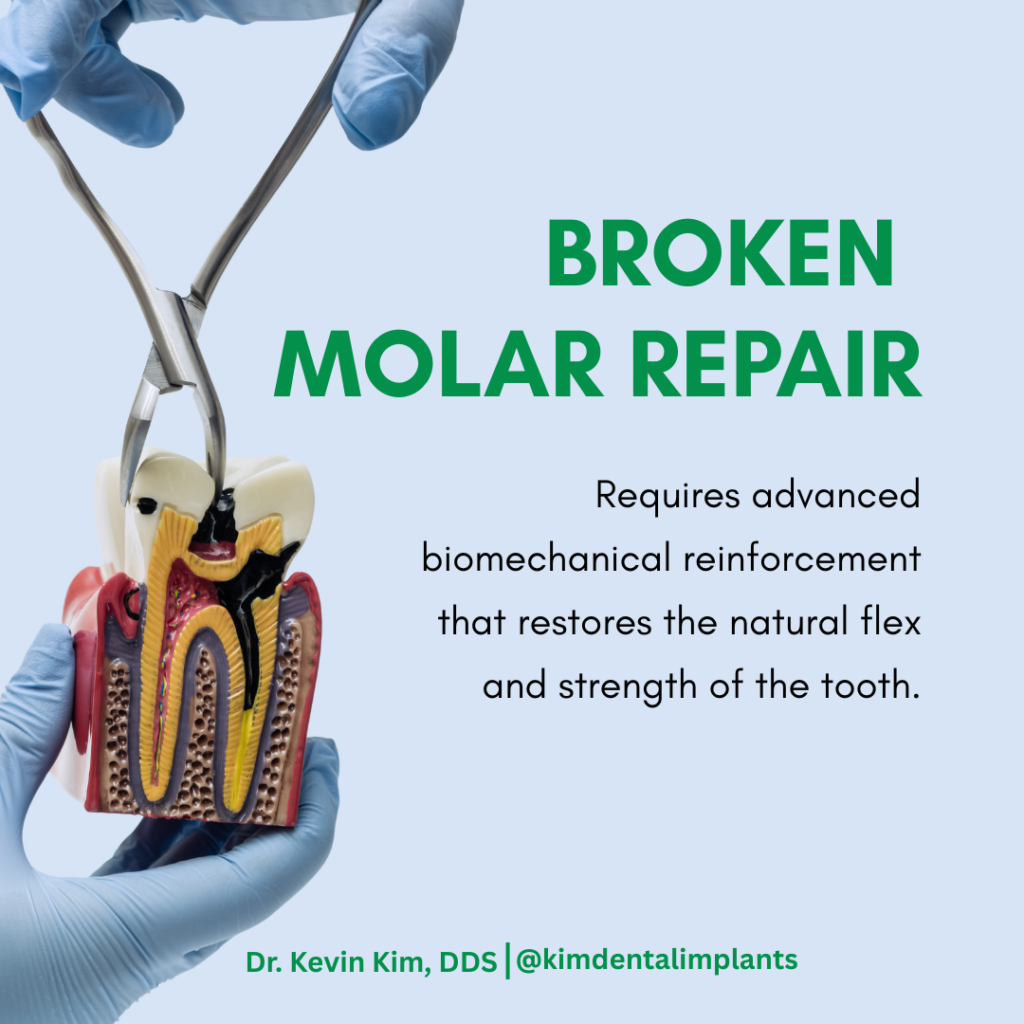
Your back molars are the workhorses of your digestive system, absorbing massive crushing forces every single day. When a large chunk of a molar shears off—often due to an old, brittle silver filling or unnoticed internal stress fractures—a simple surface patch will not suffice. Implementing a durable broken molar repair requires advanced biomechanical reinforcement that restores the natural flex and strength of the tooth.
For teeth with significant loss of structure, we utilize a specialized tooth fracture treatment known as a core build-up. We use high-strength, micro-hybrid composite resins that chemically fuse to the remaining tooth fragments, mimicking the natural strength and elasticity of dentin. If the tooth has previously undergone a root canal, we may carefully place a fiber-reinforced post into the root canal space to act as a stabilizing internal anchor for the new core, distributing stress evenly down the root.
In cases where a fracture extends slightly beneath the gumline, there may not be enough exposed tooth structure to securely hold a new restoration. To fix this, we perform a precision micro-surgical procedure called crown lengthening. By gently reshaping a fraction of a millimeter of the surrounding gum tissue and bone architecture, we safely expose a stable column of healthy enamel, ensuring your new crown can form a permanent, airtight seal.
The Mechanical Impact of Bite Imbalances
Even the most beautifully crafted dental restoration will fail prematurely if it is subjected to uneven mechanical stress. If your bite feels off when you close your mouth or chew, it means a specific tooth or crown is making contact a fraction of a millisecond before the rest of your teeth, absorbing the initial shock of your jaw closing.
This subtle misalignment turns the affected tooth into a lightning rod for chewing forces. Every time you swallow, chew, or clench, hundreds of pounds of localized pressure slam directly into that single restoration, acting like a miniature jackhammer. Over time, this repetitive trauma fatigues the dental cement, breaks the microscopic bond, or cracks the underlying tooth root, highlighting why balancing your bite is essential for protecting your dental work.
Restorative & Structural Q&A
Stabilize Your Smile for a Productive Fall
A crown that keeps falling off or a back tooth that fractures is a clear sign that your oral health foundation is under too much mechanical or biological stress. Trying to ignore these failures or relying on temporary drugstore fixes will only lead to more complex problems later on. Taking the time to properly diagnose structural damage and balance how your bite feels is the only way to secure a permanent, worry-free smile.
Don’t let a failing restoration disrupt your busy fall schedule. Dr. Kevin Kim and his highly trained clinical team in Lakewood, WA, specialize in diagnosing complex structural failures and performing durable, long-lasting broken molar repairs. Contact our office today to schedule your comprehensive structural evaluation and fix your recurring crown issues for good!